Stephen Turner:AI评审在对比实验中胜过人类评审
AI Reviews Might Beat Human Peer Reviews
Stephen D. Turner评论哈佛Gary King与Steven Worthington的新研究:134对同一稿件的AI与人类评审中,AI评审在作者构造的所有指标上占优,三名前期刊编辑在30次盲评中26次选AI评审。作者认为这支持让AI承担帮助作者改进论文的评审工作,但研究未涉及编辑决定是否发表这一职责。
历史解读
一场关于评审的评审
Stephen D. Turner先讲了一件带讽刺意味的事:他参与撰写的一篇讨论AI在同行评审中位置的论文,本身在评审流程里卡了六个多月,原因之一是返修后至少一位审稿人不再回应。他用这个经历引出Paul Bloom在《Chronicle》上提出的问题:评价AI评审,不该拿它和理想审稿人比,而该和现实中的中位审稿人比——疲惫、超负荷、免费劳动。Bloom建议做一个简单实验:收集同一批论文的人类评审与AI评审,让人来比较。Turner说,哈佛定量社会科学研究所的Gary King与Steven Worthington已经做了这个实验,论文题为《AI Article Reviews Dominate Human Peer Reviews at Their Best: Evidence and Policy Choices》。他不喜欢“dominate”这个词,但请读者先看结论:在作者能构造的每一项指标上,人类评审都输了。
实验怎么做的
按Turner的转述,研究比较了134对针对同一稿件的AI评审与人类评审。人类评审来自哈佛的rapidPeer服务,该服务付费请外部专家在投稿前为教师草稿撰写长篇、建设性、双盲的评审;作者对这些评审评价很高,一些前期刊编辑也告诉研究者,这是他们见过的最好评审之一。AI一侧使用Claude Opus 4.8,并给予与人类审稿人相同的评审说明。
评价分几层。GPT-5.5对每一对评审做盲评,每次都更偏好AI评审——Turner自己也说,这或许不算意外,AI可能偏爱AI的写法。更关键的是三名前期刊编辑,他们不知道每对中有一份来自AI模型,在30次判断中26次选中AI评审。此外,AI评审对稿件作出的错误陈述约为人类评审的三分之一,且没有引用任何伪造来源。Turner还提到,当比较被限制在长度相近的评审之间,或把人类评审改写成AI风格后,AI评审的优势仍然存在。这些数字来自Turner对论文的转述,材料未提供完整方法细节。
分工该往哪边挪
Turner此前与Agnieszka Swiatecka-Urban、Arjun Krishnan合写过一篇论文,主张让AI在同行评审中充当质量控制与一致性工具, novelty与可行性判断仍由人负责。看到King与Worthington的结果后,他觉得这个分工对“帮助作者改进论文”这部分来说可能过于保守了。
但他强调,研究者本人也谨慎说明,结果并不涉及评审的另一项工作:帮助编辑决定什么该发表。Turner认为这或许正是人类角色现在该待的地方——一篇方法可靠的论文是否重要到值得某本期刊刊出,是关于一个领域应该读什么的判断,需要由可被问责的人来做,而不是AI。
可以怎么改,以及先自己试一次
Turner概括了King与Worthington提出的几种政策选项:期刊公布官方评审提示词,作者据此反复修改,提交最终AI评审并附信说明分歧;或要求投稿时附上由期刊官方提示词生成的AI评审,以及作者对遗留问题的说明;编辑再读一份用不公开提示词生成的AI评审,疑难稿件仍请人类审稿人,最终由编辑决定。Turner说这接近Bloom文章中半开玩笑的提议。
他也给出一个不必等期刊采纳的做法:下次投稿前,把稿件和期刊的审稿指南交给当前的前沿模型,先写出如果人类提出同样意见自己会怎么回应。Bloom曾对一篇已投给顶级认知科学期刊的论文这样做,Claude建议拒稿并要求补两项研究,Bloom写道他希望自己早点做这一步。Turner还提到,King与Worthington在披露中说明使用了企业账户的AI,但未细说用法;他自己则用Opus 5.5按PNAS研究报道的要求评审了这篇论文,认为该评审指出了设计、分析上的真实局限,并批评了在有限结果下对结论的明显夸大。他提醒,若要这样做,应使用关闭训练或“为所有人改进模型”选项的付费账户;如果稿件内容极其突破、不宜在评审发表前被任何人或机器看到,那也许根本不该这么做。
正文 · 原文
Back in March I wrote paper with a few colleagues about AI’s place in peer review. The preprint is here, and I wrote a short post about it here.
Now there’s some irony here. A good part of the introduction motivates the paper’s proposal by bemoaning the fact that the peer review machinery is buckling under the weight of an ever increasing number of submissions (surely driven by AI in part). The irony here is that our paper, which proposes a partial solution to the problem of overburdened peer review, has been stuck in peer review for over 6 months because at least one of the reviewers wasn’t available or responsive after we turned around a revision in <1 week.
Paul Bloom, who edits Behavioral and Brain Sciences, recently wrote in the Chronicle that the interesting question to ask about AI in peer review is how well it does against the available alternative, the median reviewer (who is tired, overburdened, doing hard work for free because P&T expects and rewards it, etc.). He proposed an experiment: collect human and AI reviews of the same papers and have people compare them.
It would be useful to run some simple experiments: Ask researchers, scholars, and editors from different fields in the sciences and humanities to compare human reviews and AI reviews across a range of dimensions.
Gary King and Steven Worthington at Harvard’s Institute for Quantitative Social Science have now run that experiment. The new paper is called “AI Article Reviews Dominate Human Peer Reviews at Their Best: Evidence and Policy Choices.” I don’t like the word choice of “dominate,” but put that aside for a moment and at least consider the top line finding:
The human reviewers lost on every measure the authors could construct.
Here’s figure 1 from the paper.
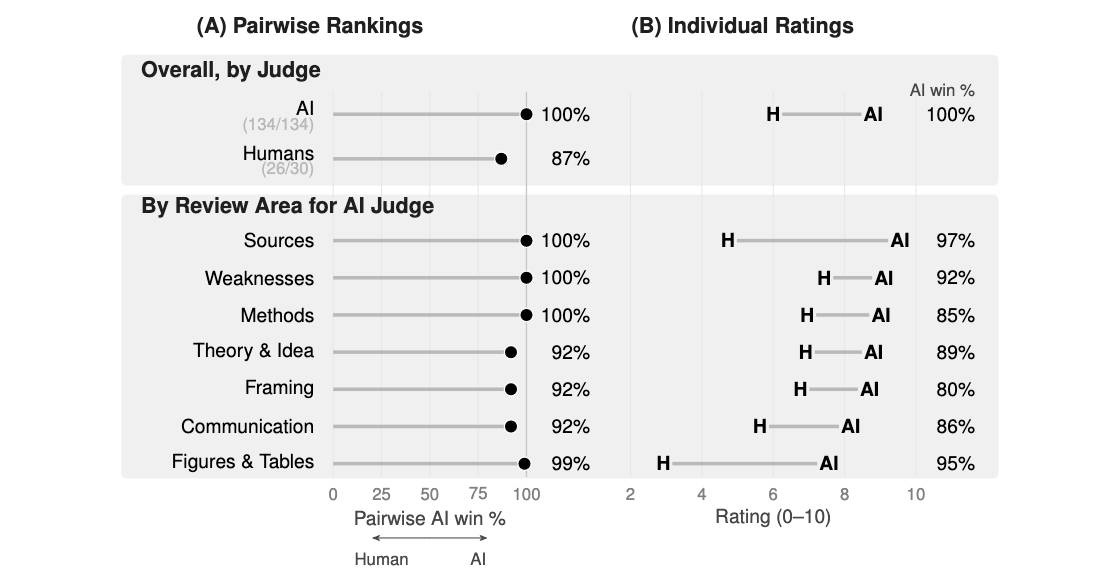
In a way the design actually favored human reviewers. The 124 papers came from rapidPeer, a service at Harvard that pays outside experts to write long, constructive, double-blind reviews of faculty drafts before journal submission. Authors rated these reviews highly, and former journal editors told King and Worthington they were among the best they had seen. Claude Opus 4.8 reviewed each paper with the same reviewer instructions. GPT-5.5 judging each pair blind preferred the AI review every time. Maybe that’s not unexpected. You’d think that AI likes AI’s writing. Three former journal editors, who didn’t know one review in each pair came from an AI model, picked the AI review in 26 of 30 judgments. The AI reviews made about a third as many incorrect claims about the manuscripts as the human reviewers did. The AI reviews cited no fabricated sources. The AI reviews also kept their advantage when the comparison was restricted to reviews of similar length or when the human reviews were rewritten in AI style.
So back to that paper I wrote with Agnieszka Swiatecka-Urban and Arjun Krishnan arguing for AI as a quality-control and consistency tool in peer review, with humans keeping the judgments about novelty and feasibility. For the part of review that helps authors improve a paper, King and Worthington’s results make that division of labor look maybe a little too conservative! The authors are careful to say their results don’t address the other job of review, which is helping editors decide what to publish. Maybe this is where the human role now belongs. Whether a sound paper is important enough for a given journal is a judgment about what a field should read, and I think a person who’s accountable has to make that decision, not an AI.
I think that leaves us as academics in a place where we need to really think about how the practice of science should adapt to what AI can already do now and where it’s going. And we need to do so fast. King and Worthington sketch one version. Journals could publish an official review prompt, and authors iterate against it and submit the final AI review with a letter explaining where they disagree.
Third, journals could require an AI review, generated by the journal’s official AI prompt, be submitted with the paper, as well as a letter from the author explaining any remaining open questions or disagreements with AI.
The editor could read that dossier alongside a second AI review from a prompt kept private, calls in human reviewers for hard cases, with the editor ultimately making the decision. It is close to the half-serious proposal in Bloom’s essay, down to the public prompt.
You can start before any journal adopts it. Before your next submission, give the manuscript and the journal’s reviewer guidelines to a current frontier model,1 and draft the response letter you would write if a human had raised the same points. Bloom tried this on a paper he had already submitted to a top cognitive science journal. Claude recommended rejection and asked for two more studies, and he wrote that he wished he had run it first.
The authors noted in a disclosure they used an enterprise account (frontier) AI in this paper, but didn’t really say how. That’s fine, I’m skeptical of AI disclosures anyway. The authors already ran this through an online AI, and the paper is publicly available online anyway. So I think it’s fair game to run this paper through an AI yourself.
Because the authors seem to frequently submit to PNAS, and because the paper clocks in at just under the 4,000-word limit for a PNAS research report, I prompted Opus 5.5 to review this paper as if it were being submitted to PNAS. The full review along with the detailed prompt I used to review this paper are both here.
Read the AI review of this paper
The review in this case pointed out some real limitations in design, analysis, and called out blatant overstatement of the conclusions given the limited results. Read the full AI review here. Preview below.

Obviously do so on a paid account where you have training or “improve the model for everyone” turned off. See here for more. Or maybe don’t do it at all if there’s something so seriously groundbreaking in your manuscript that you wouldn’t want any eyes, human or machine, to see it before it’s peer reviewed and published.
来源:Stephen Turner · 研究评论 · blog.stephenturner.us