《AI寡头围拢护盘:黄仁勋复职与英伟达的“央行”地位》
The AI oligarchy circles the wagons
英伟达CEO黄仁勋因与一名被美方认为是中国情报人员的女性有婚外情等不当行为被董事会罢免,数日后又突然复职。文章认为,英伟达股价暴跌拖累CoreWeave等AI公司及标普500全年涨幅,市场担忧黄仁勋个人关系对AI产业不可或缺;特朗普公开施压,副总统万斯私下与黄仁勋及董事会沟通,并保证其不构成国家安全威胁、不面临刑事指控,交易在周末达成。作者称这是“AI寡头”运作的实例。
正文 · 原文
Even though I use the term myself, and even though I’ve written about the subject at length, “tech oligarchy” has always come off my tongue a bit uneasily. Echoes of the semantic debates over describing the Trump administration as ‘fascist’ here, I suppose, with the attendant reservations: Is this really where we are? Have things really gotten so bad?
The events of the last week have demonstrated that, yes, broad-daylight oligarchy is really where we are. And yes, apparently they have.
The sudden reinstatement of disgraced Nvidia CEO Jensen Huang is astonishing in its open broadcasting of this arrangement. In any other post-robber baron, pre-AI boom era of the American economy, a CEO of a top company overseeing key national security interests who was ousted for having an affair with a woman believed to be a foreign spy and an unknown number of direct reports, too, would stay ousted.
The board of Nvidia itself apparently harbored this assumption, that they were still operating according to the rules of a Fortune 500 company participating in a modern market economy, and not an AI-infused oligarchy, as that board not only voted to remove Huang for his gross misconduct and breaches of trust, but then confidently reaffirmed that he would not be returning again, days later.
Well, he’s back after all, much to the apparent delight of the employees he is enriching.
So what happened? Well, the stock market started to crater, taking down not just Nvidia shares, but neocloud companies like CoreWeave and other AI firms along with it. The recently IPO’d Anthropic, who, like most AI companies, rely on Nvidia chips to train and run its LLMs, saw its shares fall, too. The S&P 500’s gains for the year were wiped out in a week.
The market was freaking out because of Nvidia’s particular role as the “central bank” of the AI industry, and Jensen Huang’s unique ability to administer it. As has been noted many times in these pages, and by other analysts and critics, the AI industry’s foundation is built on a circular economy, where Nvidia invests in companies so they can in turn buy Nvidia’s chips. Investors know on some level that this is not a solid or sustainable arrangement in the long run, so they started to jump ship. This is pretty much exactly what having an oligarch in control of an industrial sector looks like. Jensen Huang’s personal relationships to clients, state officials, and dealmakers are so integral to the AI industry that the money thinks the wheels might well come off the whole thing without him. Remember, AI’s chief promised export is one-size-fits-all labor automation, so the stakes are especially high.
That being the case, the state and Huang’s fellow oligarchs rushed to protect their interests. Most crucially, Donald Trump openly pressed for his reinstatement. The two have been close throughout his presidency; Huang and Nvidia have donated tens of millions of dollars to Trump’s inauguration fund and to his White House ballroom project, and Trump has personal investments in Nvidia worth tens of millions more. Trump personally granted Nvidia an exemption on export controls over chips so Huang could sell more of them to China. Naturally, Trump wanted him back in. Here’s the New York Times with the details of how he got his way:
President Trump had just returned to Washington from China at the end of last week, and his desire to have Jensen Huang reinstated as Nvidia’s chief executive was only intensifying, especially as he watched the stock market slide on Friday.
So Mr. Trump, who for weeks had been downplaying revelations about Mr. Huang’s affair with a woman believed by U.S. officials to be a Chinese asset, decided to turn up the heat.
Mr. Trump asked Vice President JD Vance, who came to office with close ties to Silicon Valley, to talk to Mr. Huang and work with Nvidia’s board. Over the weekend, Mr. Vance spoke privately with Mr. Huang, people with knowledge of the matter said. And he worked to get the board two things it would need to bring back a leader it had forced out little more than a week earlier amid a global scandal and had subsequently made clear it had no interest in rehiring.
One was an assurance that the Trump administration did not believe that Mr. Huang, who has admitted the affair, was a threat to national security. The other was a statement that Mr. Huang was not facing criminal charges.
Only a tiny handful of officials at the highest level of the government were aware of these conversations. An equally small group at Nvidia was read in.
By late Sunday night, the deal was done. And it was announced on Monday morning in coordinated statements, first from Nvidia and then from Mr. Trump, stunning Washington and the tech world and sending Wall Street — the president’s favorite proxy for his job performance — rocketing higher.
The AI oligarchy in action, folks.
Much has also already been said about fellow tech billionaires working the phones for Huang, and the examples range from pathetic—posters simping on X about how Huang is such a great entrepreneur the rules shouldn’t apply to him or ousted Uber founder Travis Kalanick wearing a leather jacket in solidarity—to strategic and self-interested. Most often, perhaps, it was both. Venture capitalist and All-In podcast host Jason Calacanis made the cable media rounds to push the case that Huang is “one of the ten or twenty best entrepreneurs in the history of business” and so “transcendently good” at his job that he should be able to do whatever he wants so as to lead us into the AI future.
It could be that Huang is a shining light from the Valhalla of innovation, sure, or, and bear with me for a minute, it could be that people like Calacanis have such a large financial interest in Nvidia not unraveling, because that would take down a huge swath of their investment portfolio with it, that they’re happy to perform some exceedingly grating hero worship of the man who apparently sleeps with every woman that walks past his office.
As the sociologist and tech critic Jathan Sadowski has pointed out, the Valley-driven campaign to reinstate Huang is redolent of the industry’s response to the Silicon Valley Bank collapse of a few years ago. In that episode, you might recall, VCs, Valley figureheads, and specifically, the All-In podcast cohort worked feverishly to mount a public pressure campaign to get the government to intervene and bail out the bank, where prominent tech firms and investors held money in higher-risk, higher-reward accounts that were at risk of taking a hit. One of the biggest cheerleaders was David Sacks, an All-In co-host, who is now both a VC and now an advisor in the Trump White House. In that case, the campaign succeeded, and the FDIC issued a backstop guaranteeing that everyone who held uninsured deposits in SVB would be made whole.
Essentially, the bank, which offers preferential rates and services to investors and account holders unavailable to ordinary Americans, was saved by offloading the risk and costs to those ordinary Americans. And Silicon Valley learned it can call in favors, take to social media and cable talk shows, and, especially if the market appears to be at risk, get its way. All while avoiding any accountability. This is an oligarchy in action! And it’s both reliant on and in near-complete control of the AI sector, an industry that accounted for a full 40% of the growth in the American economy last year.
And guess what? Barring serious, systemic intervention, it’s is only going to get worse from here on out. The AI firms are facilitating a mass transfer of wealth that is enriching elites (and minting new ones) while exploiting and aiming to undercut labor en masse. They are, in essence, cementing the conditions for the continued flourishing of the oligarchy we saw in action this week. There’s no better example than Anthropic.
Some of you have likely seen this chart going around, shared by former Obama adviser and Wall Street financier Steve Rattner, showing that Anthropic’s 5,300 founders and employees now hold as much wealth as the bottom third of U.S. households. (That’s 45 million households, if you’re counting.)
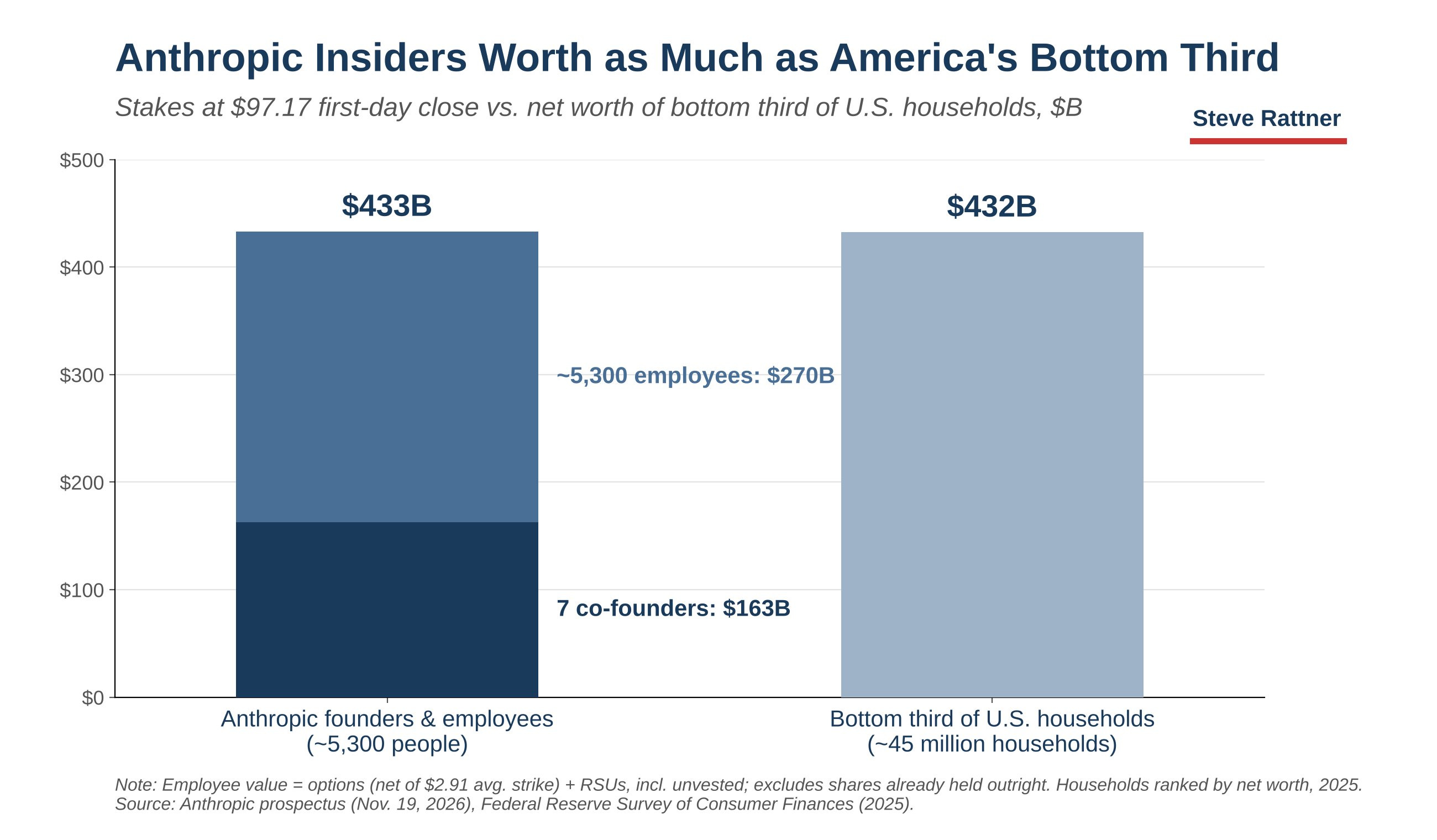
This is a pretty staggering statistic, and one that adeptly reflects the vast inequality gulf in the United States, and the way that the AI industry is rapidly exacerbating it. Here’s another one: If Anthropic were a city, it would have the third most centimillionaires—people worth $100 million or more—in the world. That’s behind only New York and San Francisco. There are more $100 millionaires at Anthropic than live in London, Los Angeles, or Paris, as Fortune points out:
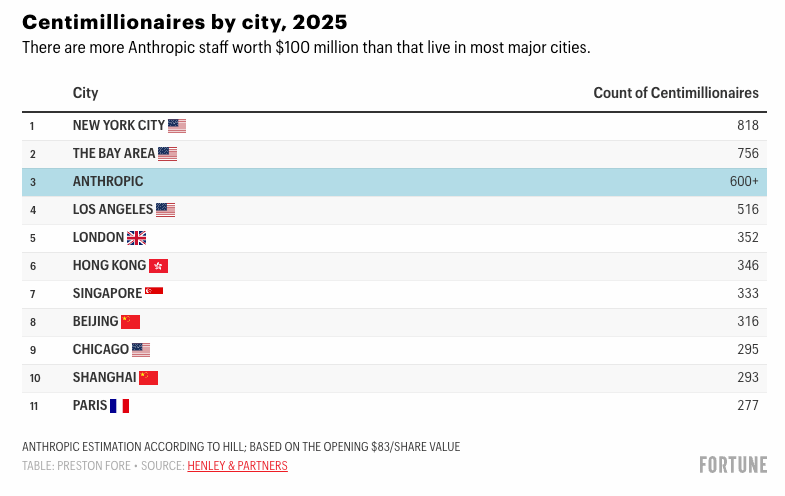
I do think it’s some dark irony that Anthropic clocks in just above Los Angeles, for decades the entertainment capital of the globe; Anthropic has minted more centimillionaires than the entire city in part by ingesting the creative works of artists, writers, and producers and converting them into a commercial product.
Now, there are signs that even Huang’s return to Nvidia haven’t been enough to durably right the ship, as the stock market took another hit just two days after his reinstatement. Anthropic’s stock, meanwhile, ended the day below its IPO listing price, as the entire sector continues to wobble.
Here’s , writing about what he calls the big splat:
But as it turns out, all we got from this abandonment of accountability, this resounding affirmation that if you’re an oligarch, they let you do it, was … a one-day dead cat bounce. AI stocks and tech stocks in general are, as I write this, basically back to where they were before Impunity Day. All indications are that the deflation of the AI bubble has resumed.
So we got the degradation, the betrayal of national interest, the abandonment of ethical standards, the open season for corruption, for nothing.
Happy Thanksgiving.
Happy Thanksgiving indeed. The big question is how long the oligarchy can continue to resist accountability and exercise power this way; how long it will be allowed to override the demos and compound its own wealth at our expense. Especially now that the pitchforks are raised and the data centers are in the crosshairs. For my part, I’m thankful to all you out there who are taking up the proverbial hammers to contest the AI oligarchy, however you’re doing it. Enjoy the turkey days, rest up, and more soon.
As always, this work is nearly 100% reader-supported, and thus depends on paying subscribers to help me do it. If you’re a regular reader, and find value in this writing, please consider upgrading to a paid subscription for the cost of a cup of coffee or a light beer a month. I truly appreciate all those who already chip in; it means a good deal. See you after the holiday.
来源:Blood in the Machine · 讨论信号 · bloodinthemachine.com